Protegen importante zona de alimentación de tortugas marinas en Uruguay.


Incorporan a Cabo Polonio al Sistema Nacional de Áreas Protegidas como Parque Nacional

El ministro de Vivienda, Ordenamiento Territorial y Medio Ambiente, Carlos Colacce, anunció la firma, por parte del Poder Ejecutivo, del Decreto que incorpora Cabo Polonio al Sistema Nacional de Áreas Protegidas como Parque Nacional. La directora de la DINAMA dijo que se construirá el Plan de Manejo con normas relacionadas a la protección de las distintas zonas, a través de áreas de uso turístico intensivo y zonas de uso parcial.

http://www.presidencia.gub.uy/_Web/noticias/2009/07/2009072003.htm

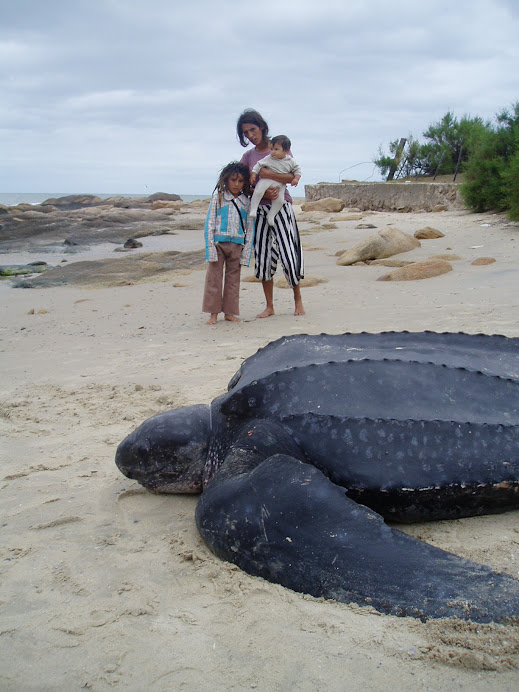
Esta información trae buenas noticias para la protección de las tortugas marinas a nivel mundial. La tortuga verde (Chelonia mydas) es un animal que se encuentra en peligro de extinción según la UICN 2008 (Unión Internacional para la Conservación) y su distribución geográfica abarca todos los océanos del mundo dentro de zonas tropicales, subtropicales y templadas; en la costa atlántica americana se encuentra entre los 40º N y los 40º S. En Uruguay se distribuye a lo largo de toda la costa siendo la zona de Cabo Polonio una de las áreas más importantes de alimentación y desarrollo en el país y en la región. En el Polonio, la tortuga verde, se alimenta de algas marinas en las puntas rocosas y zonas insulares.


Desde 2001, la organización Karumbe (www.karumbe.org) trabaja en la zona de Valizas - Cabo Polonio investigando y realizando acciones de conservación de las tortugas marinas que habitan el área. Toda esta información será utilizada para realizar un plan de manejo de tortugas en este reciente creado Parque Nacional.

Volunteers are needed to work with juvenile green turtles in Coastal-Marine Protected Area

Volunteers are needed to work with juvenile green turtles in Coastal-Marine Protected Area

Period: november 15th 2009 – April 30th 2010 - Location: Cerro Verde,Uruguay.
http://www.facebook.com/pages/Canelones-Uruguay/Karumbe/42781002639


Background Information: Karumbé has been monitoring this foraging and developmental area of juvenile green turtles (Chelonia mydas) for more than 10 years. In this site the volunteers will carry out research and conservation activities, getting quite in touch with the fishermen community where the field station is settled. Volunteers will be working shoulder to shoulder with the 3 researchers who will be coordinating the fieldwork, getting involved in all tasks included in the project work.

It is not necessary to speak Spanish; however we encourage candidates to know at least the basics.

Site Information: Cerro Verde is a landscape of protected area (Bañados del Este and Coastal Fringe - Biosphere Reserves). In this particular case the green turtle can be considered effective 'umbrellas' for broader biodiversity. Cerro Verde comprises high diversity of fauna and plant communities including relict vegetation, marine mammals (as fransiscana dolphins, bottlenose dolphins, sea lions) and seabirds. This area has just been included in the recently created National System of Protected Areas (SNAP) as the first Coastal-Marine Protected Area. Thus it is a priority to increase the research in order to succeed in preserving the biodiversity and allows developing a management plan according to the reality and needs of this marine ecosystems.

Duties:
The volunteers will conduct the following activities:
1. Sighting and capturing, with nets, juveniles of green turtle, in areas next to the shore.
2. Walks (10-20 km.), searching for stranded sea turtles.
3. Help researchers with necropsies of any dead individual.
4. Collect data of the artisanal fishery carried out in this locality.
5. Get involved in talks and workshops for the community and tourists.
6. Rehabilitation of sick and weak sea turtles.
7. Help in the field station duties such us cleaning and cooking.

Requirements: Candidates should have (a)
1.Willingness to work with nature in a remote place, surrounded by beautiful landscapes.
2. Good physical conditions: know how to swim and be able to walk long distances on loose sand.
3. Willingness to get to know a different culture, getting involved into conservation activities with this fishing community.
4. It is not necessary previous experience in handling sea turtles, training will be given as soon as arrived in the field station.


Additional Contact Information: Biol. Luciana Alonso, Volunteers Coordinator.
If interested ask for the volunteer's instructive at: volkarumbe@gmail.com
www.karumbe.org
Karumbé, Uruguay.
Cel - 00 54 911 55143665

Almanaque 2009

Para acceder a la mayor calidad, haz click en la imagen.